Semantics
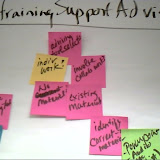
This week we met with our client to review where we are with VCC concept mapping. You should see how many pages of newsprint are required to accommodate our lovely stickies ... so many in fact, we covered the client's office with them! In our review, we struggled a bit communicating the various labels we created for each user intention in the system. Not only that, but as we reviewed the area where Best Practices would be housed for review and participant contribution, it was clear the team and our client had different definitions of Best Practices. The team referred to Best Practices as it relates to the functionality of the VCC (Best Practices for Training Development Tools, Best Practices for Instructional Design of Online Training) and not necessarily related to the development of training content as it relates to our audience's main interest -- Assistive Technology. The funny thing was, after the client meeting when the team began to revise the concept mapping based on this new information, we started tripping over our labels as well. One discussion started like this - "Well, I think that (pointing to one of our lovely stickies) is a definition, not a description." Seriously, I really don't see the difference, but to make everyone happy, we coined a new word - defiscription. Lesson learned - you need to gain an intimate understanding of the client's vocabulary. We realized that we needed to get some of our audience members in pronto to review the concept mapping and to get a better handle on the best way to present information in our VCC prototype.
Nearing the end now -- only a few more weeks to go!
Showing posts with label concept mapping. Show all posts
Showing posts with label concept mapping. Show all posts
Sunday, April 20, 2008

Thursday, April 3, 2008
Immersion, Spring Semester -- Week 10

Becoming One with the Sticky Note
As we continue marching towards a semi-functional prototype of the VCC, we have embarked on an interesting phase in this abstract usage-centered design process – content modeling. It sounds like it would be concrete, doesn’t it? But Constantine & Lockwood like to keep things simple – abstract, but simple. How do you map content that begins to pave the way to the user interface without launching into visual design? With sticky notes, of course! To quote our instructor, using the sticky notes during the concept mapping process will allow us to brainstorm every sort of interaction possible and in every sort of combination. It also easily allows us to edit interactions where we see redundancies. It is exciting since I can see some patterns emerge that will be involved in global navigation and make up the backbone of the site. Constantine & Lockwood (1999) call the paper and Post-it note artifact that evolves through content mapping a “high fidelity abstract model” (p. 127). I have provided an example of our so-called “high fidelity” model above. Of course, now we are struggling with how we get feedback on our concept mapping, especially if we need to meet in another building on campus. Perhaps we need something like this …
Constantine, L. L., & Lockwood, L. (1999). Software for Use: A Practical Guide to the Methods of Usage-Centered Design. Reading, MA: Addison Wesley Longman, Inc.
Subscribe to:
Posts (Atom)